Skip to content

Category: Interview

  • Looking Back at the Water Innovation Challenge

    Looking Back at the Water Innovation Challenge

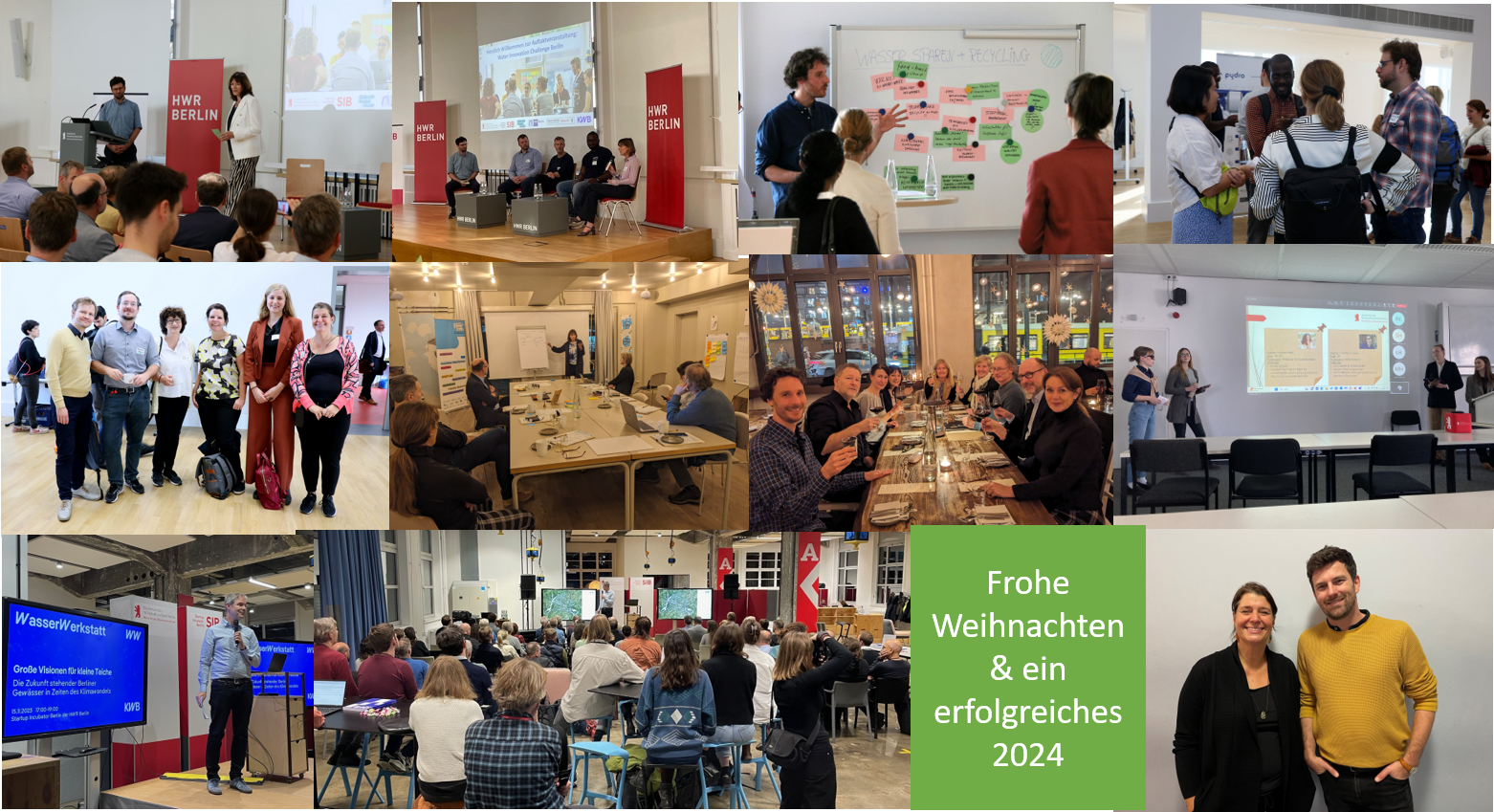
    At the end of the year, we are pleased to give you a brief retrospective and status update on the ongoing Water Innovation Challenge:

    At the beginning of the year, the IHK Berlin and the Startup Incubator of HWR Berlin launched the ‘Water Innovation Challenge Berlin’. Initially, extensive interviews were conducted with stakeholders from the business community, from which problem statements and challenges on the topic of “Sustainable Water Management” emerged.

    In the subsequent cooperation and transfer formats, stakeholders from business, research, and society were able to network and develop joint projects.

    Thanks to the newly gained cooperation partners, the Berlin University Network “Zukunft findet Stadt“, Berlin Partner, and the Kompetenzzentrum Wasser Berlin gGmbH, it was possible to initiate a diverse range of events and projects. We would like to briefly introduce a few selected ones:

    Kick-off Event “Water Innovation Challenge”

    At a kick-off and networking event on October 11 at HWR Berlin, interested stakeholders from business and research were able to meet and exchange ideas in several working groups on the previously identified focus topics of Sponge City, Legionella, and Water Reuse.

    Innovation Work Retreat (IWR)

    In a two-day workshop, business and practice partners (including Berliner Wasserbetriebe) and researchers (BHT, HTW, HWR) approached the topic of Legionella in an interdisciplinary manner and jointly discussed approaches to problem-solving. The result: an agreement on a research proposal to explore the topic in greater depth. The IWR is a format of the transfer project “Zukunft findet Stadt”.

    Research Projects & Thesis Papers

    Small and medium-sized as well as large companies are involved. Discussions and initial implementations of research proposals and thesis papers are underway and ongoing on topics such as water reuse in hydrogen electrolysis, tracing wastewater flows, and the potential for their recycling. Here, “trao – die Transfer-Roadshow”, another format of “Zukunft findet Stadt”, is being utilized.

    A first major research proposal for the establishment of a real-world laboratory has already been submitted. This concerns the testing of multiple uses of urban agri-photovoltaic areas for integrative and local agricultural, energy, and mobility solutions including irrigation concepts.

    Student Projects

    As part of the module “Engagement for Sustainability and Social Responsibility”, six student teams from HWR Berlin developed innovative solution approaches to questions posed by three practice partners in a semester project using Service Design / Design Thinking methods. As part of the concept development, the students conducted various interviews and on-site visits. The extensively prepared results presentation before the three project partners, as well as further in-depth discussions, took place on December 1 at HWR Berlin’s Campus Lichtenberg.

    Startup Challenge ‘Sustainable Water Management’

    For 2024, the Startup Incubator of HWR Berlin, together with Kompetenzzentrum Wasser gGmbH, is planning a startup challenge format in which Berlin startup teams & prospective founders will develop innovative prototypes & concepts addressing challenges from practice partners in the field of ‘sustainable water management’. If you would like to participate as a challenge provider or sponsor, please feel free to contact us.

    We would like to thank all those involved for their ideas and the strong collaboration thus far.
    If your company is not yet in contact with us but might be interested, please feel free to get in touch. Contact: Sandra Thumm sandra.thumm@hwr-berlin.de and Falko Carl falko.carl@hwr-berlin.de.
  • The Magic of Startupnight – SUN X Digital Week

    The Magic of Startupnight – SUN X Digital Week

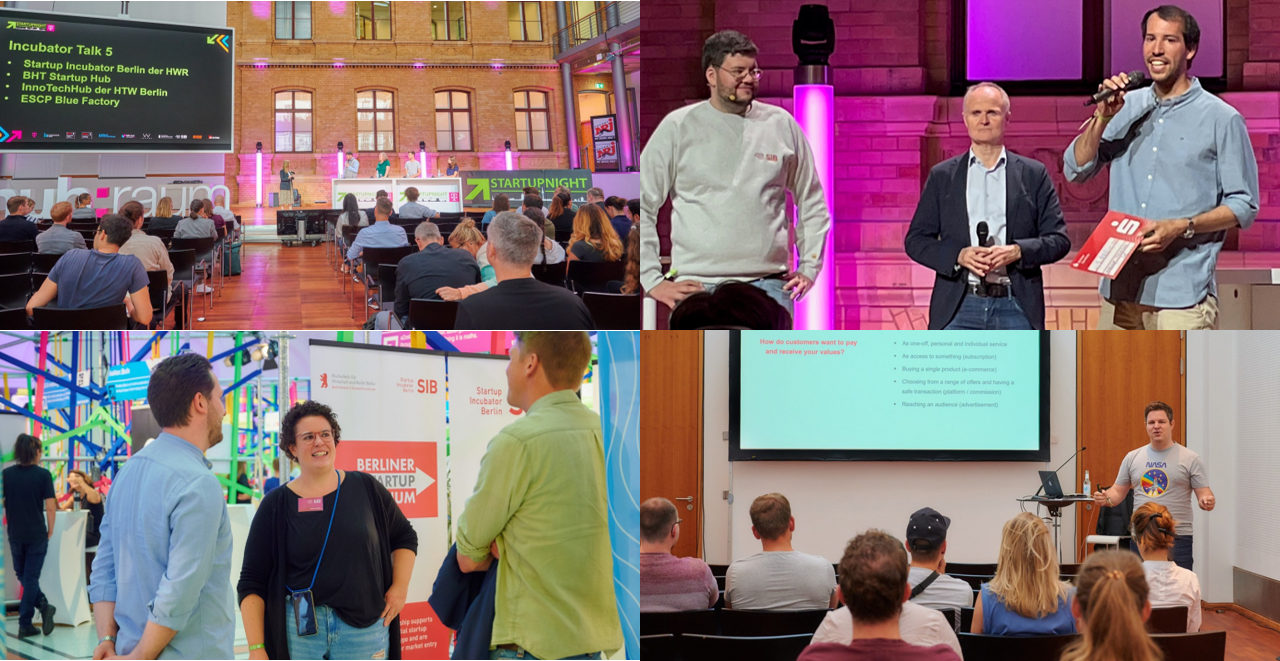
    The #Startupnight 2022 was special in many ways: The networking event for the startup ecosystem celebrated its 10th birthday (hence the title SUN X), it came back as a big live event after two digital editions during the pandemic, and it presented three full days of programming with a wide spectrum of topics, speakers, impulses, sponsors and – of course – startups.

    The Startup Incubator Berlin was an official partner and the curator of the Incubator Day on Friday, September 9th, packed with a colourful program before closing with the actual Startupnight party.

    It was an honor, and some hard work for many weeks: A steering committee was established, weekly meetings held to coordinate agendas, plans were drawn up for guest speakers and panels, workshops defined and exhibitors lists built and re-built.

    The result was a thrilling day with many highlights:

    • over 20 Incubators exhibited at the Incubator Day, bringing along one startup each to pitch against each other for Super Demo Day (€ 1000 prize award from the Berliner Sparkasse)
    • 7 Workshops were held to different topics such as the Lean Startup Method, rapid prototying, Legal 101 for Startups and more.
    • The X-Challenge took place for two days in a separate lounge to tackle the question on „How to find the perfect (business) match” . About 30 strangers came together, spontaneously formed teams and worked in a professional Design Thinking workshop on a new approach. The three finalists pitched at the end of the Incubator Day on stage, and the winning team was awarded € 2,000 by the Icecubator and Spitzhorli Invest AG.

    Over 30 Speakers went on stage to talk about their expertise and share their know-how: From project management leaders to representatives of all incubators to the Business Angel Club Berlin Brandenburg e.V. with three duos of investors and founders.

    At the end of the day, the incubators emptied their booths in record time to make space for their startups represented. An impressive collection of 120 startups exhibited at the Startupnight, from Ed-Tech to High-Tech, from Sustainability to Aerospace. So very impressive!

    So what was the magic for us in this huge project?

    The magic of the Startupnight was to see all incubator in one big hall, hard-working colleagues that all support the Berlin Startup Ecosysystem and their startups to become successful.

    And most wonderful of all was to see that our startups from the Startup Incubator Berlin where visible everywhere: There was a2zebra who pitched for Super Demo Day and reached the finals. Participating in the X-Challenge were two co-founders from our teams Trueffles and Stella. And Tina from Trueffles won the X-Challenge with her team!

    Joining the Workshop from professional Wafm Academie about the potential of team members was our team prevact. The team Cleverlohn made it in the Masterclass program of the HTW after finishing the Berlin Startup Scholarship with us. CBright and DocVox were nominated for the Pitching Stage in the evening by investors.

    More SIB teams could be found among the exhibitors, such as We4All, Sittery, Kursinsel, Hale, Robbi and our dear alumni teams such as Bearcover, Brea, LexHub and truemetrics who meanwhile joined different programs in other incubators or secured their investments already.

    What does this mean to us?

    Public funding for startups works! Our offers for our startup teams work! Working together in a wide network of the Berlin startup ecosystem works!

    And last but not least: We are very proud of our startup teams and happy to accompany them on their journey to success. Big applause!

  • Thinking differently, leading differently – Entrepreneurship

    Thinking differently, leading differently – Entrepreneurship

    HWR Berlin is among the first signatories of the Entrepreneurial Skills Charter of the Stifterverband für die Deutsche Wissenschaft. Prof. Dr. Sven Ripsas co-authored the document. An interview.

    About the Person

    Prof. Dr. Sven Ripsas is Professor of Entrepreneurship at the Berlin School of Economics and Law (HWR Berlin). He advocates for the promotion of Entrepreneurial Education in education from school through university. His central research focus is on the development of innovative business models.

    What are Entrepreneurial Skills?

    Entrepreneurship Education encompasses a wide range of future-relevant competencies along the so-called 21st Century Skills and the UN Sustainability Goals (SDGs). These skills include communication and problem-solving in interdisciplinary teams. The social-ecological transformation requires all fields of knowledge: digitalization, ecology, and economics. Above all, however, it is about restructuring teaching in schools and universities away from the mere transmission of knowledge toward agile interdisciplinary problem-solving through “discovery learning.” The university leadership of HWR Berlin supports this charter — that is wonderful.

    Where are these skills important in everyday life and work?

    Everyday life is increasingly less predictable. This will apply to a great many professions in the future and already applies today to managers, politicians, and teachers. Decisions must be made in ever-new contexts. Old strategies are not always appropriate. The focus is shifting away from planning and monitoring execution toward situational assessment of needs and opportunities and making decisions agreed upon within a team.

    Why does a society need the broadest possible Entrepreneurial Mindset across all areas?

    Quite clearly: the social-ecological transformation is a mammoth task. Furthermore, in Germany, people have not yet recognized the power of Entrepreneurship Education, even though it has been a central educational goal in the European Union for years.

    How do you get people to think and act entrepreneurially?

    We need to start at school. Entrepreneurs are not capitalists, but changemakers. The decision-makers of tomorrow are in school today. Many then go on to vocational training or university studies. This is what we have been working toward at HWR Berlin for years with the German Entrepreneurship Education Campus, which will take place again in October.

    What role do universities play, and what can they do concretely?

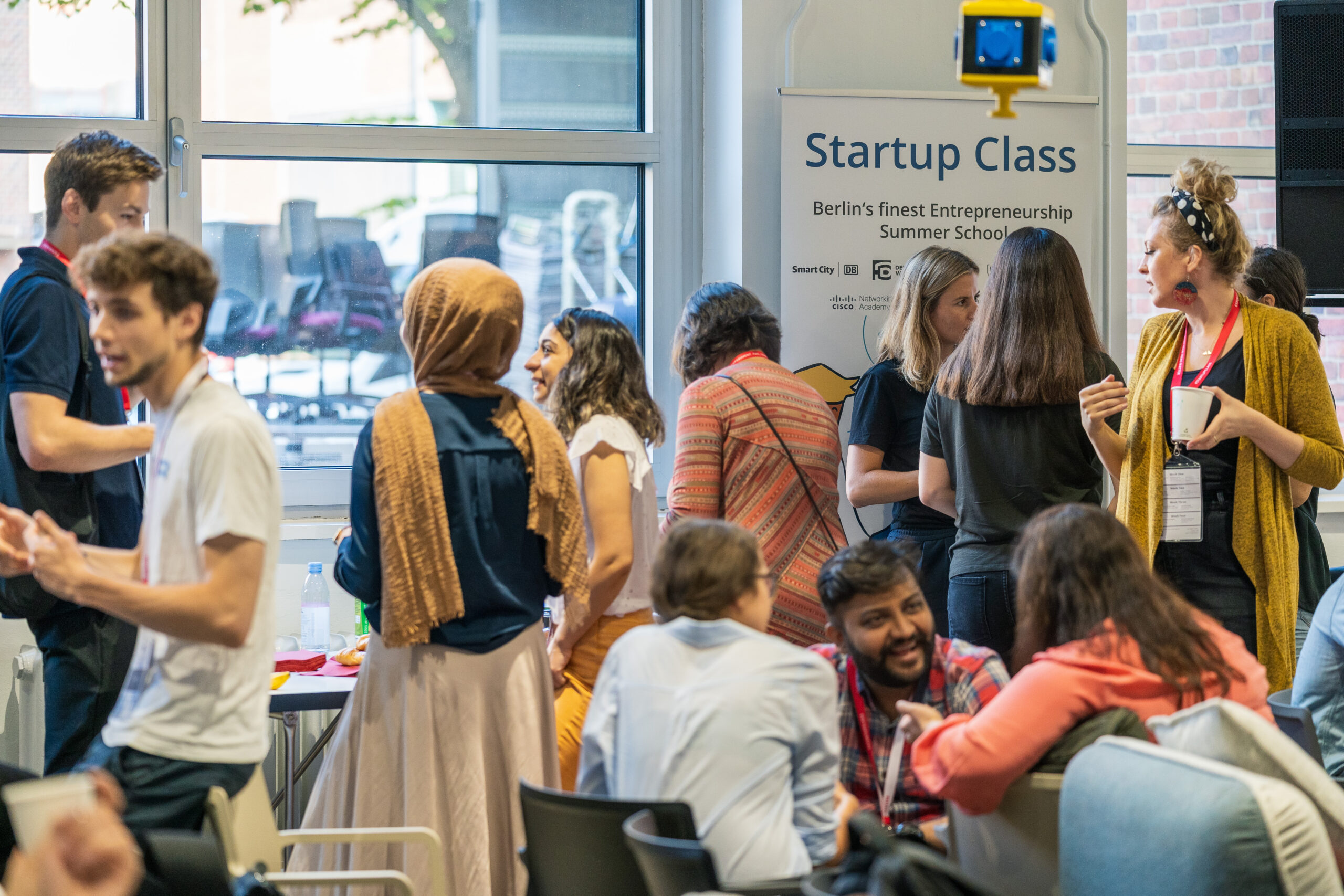
    We need a cultural shift at universities. HWR Berlin is a pioneer in this regard. We not only have special degree programs for entrepreneurs, the StartupClass of the Entrepreneurship Summer School Berlin in August, and a Startup Incubator Berlin, but we are also actively involved in conveying entrepreneurship skills to employees within companies — the keyword being “entrepreneurs within companies.”

    What would you see as the next necessary step?

    Entrepreneurship Skills must be structurally embedded in the curriculum of all degree programs. We are working on that. The recently adopted Entrepreneurial Skills Charter will help us to involve other departments beyond the economic sciences. The goal is ultimately a strategy paper for the entire university.

    You were involved in developing the Entrepreneurial Skills Charter. What is it meant to achieve, and for whom?

    The Entrepreneurial Skills Charter is a milestone. It makes clear that entrepreneurship is not only about founding companies, but is a mindset. It is about creative, interdisciplinary problem-solving at the intersection of sustainability, digitalization, and economics.

    What expertise and experience were you able to contribute?

    My focus is entrepreneurship as an economic process. My doctoral dissertation already dealt with incentive structures for entrepreneurial action. In my view, today’s Entrepreneurship Education frequently lacks the competency to properly assess market incentives and their resulting consequences in the context of political initiatives. This is where I want to make a contribution.

    On what recent occasion did you consciously apply your Entrepreneurial Skills?

    Essentially every day, because the work of a professor is project-oriented, and it always involves creating something new.

    Prof. Ripsas, thank you for the conversation.

    The interview was conducted by Sylke Schumann, Press Officer of the Berlin School of Economics and Law (HWR Berlin).

  • Startup Incubator Berlin Under New Leadership

    Startup Incubator Berlin Under New Leadership

    Startup Incubator Berlin under new leadership.

    The founding center of the Berlin School of Economics and Law now has a dual leadership with Marvin Göldner and Matthias Grytzka. The areas of entrepreneurship, startup support, and technology transfer are being strengthened.

    Berlin, January 28, 2022. With Marvin Göldner and Matthias Grytzka, two experienced startup coaches are taking over the leadership of the Startup Incubator Berlin at the Berlin School of Economics and Law (HWR Berlin). Since January 2022, they have been responsible for the entire operational management of the founding center, which provides entrepreneurship-minded students with the framework, networks, and funding they need to develop their ideas through to market-ready prototypes.

    The strategic concept development and funding acquisition for HWR Berlin will also be strengthened, with the aim of further advancing HWR Berlin’s profile as an entrepreneurial university.

    Marvin Göldner

    “I personally prepared a startup at an incubator in Munich and know from my own experience what is important for startups in the early stage. I am excited about the opportunities we can offer to those interested in founding a company and startup teams at the SIB. I look forward to further developing the university’s founding center and unlocking new growth potential with our great team. As an Innovation & Strategy Developer, I want to optimize coaching methods so that young startups at the SIB can reach the market faster.”

    Matthias Grytzka

    “I have been working at the SIB for almost five years and helped shape the HWR founding center at the A32 Entrepreneurs Forum Berlin in Siemensstadt. We provide young startup teams with an attractive co-working space, a Design Thinking Lab, and a lab for developing app applications, a prototyping workshop, and above all coaching and financial support. That is simply wonderful. I am looking forward to the ever-new creative startup teams for whose success we are laying the foundation here. Innovation is not a coincidence.”

    The Startup Incubator Berlin, the founding center of the Berlin School of Economics and Law, is a workshop and experimentation space for those interested in starting a business. Here, ideas, concepts, and the development of prototypes are supported, and founders and potential business partners are connected. It is a place of creativity, encounter, and exchange. With the Berlin Startup Scholarship and the EXIST scholarship program, founders are financially supported. The incubator is aimed at everyone who is just at the beginning of their founding idea as well as those who are already in the active founding phase.

    Photo: SIB / HWR Berlin

  • Make It Lean Contest – Interview: Novaheal

    Make It Lean Contest – Interview: Novaheal

    At the Make It Lean Contest 2020/21 there was something special this year:
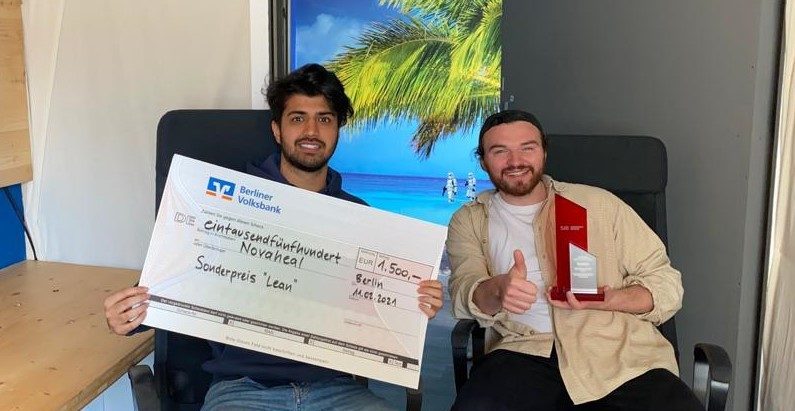
    Due to the very close vote between the two top-placed teams in the “Lean” category, the jury recommended awarding two special prizes this year as an exception. The Startup Incubator was happy to follow this recommendation and is awarding both prizes to teams that devoted themselves to a highly relevant social challenge — one with software, the other with hardware — and demonstrated their methodological approach in the best possible way.

    One of these winners is the team from Novaheal. For their idea of a learning app specifically for nursing education and preparation for a successful nursing exam, which combines proven learning methods with modern AI-supported learning analytics, they received €1,500 and the distinction of the special “Lean” prize. How did they come to participate and develop their solution, and what’s next for the founders? We asked them…

    How did you become aware of the Make It Lean Contest?

    We came across the Make It Lean Contest on LinkedIn, as I (Turan) have someone in my network who had shared a post about the competition. So it was more of a happy coincidence for us.

    How and when did you come together as a startup team?

    Samuel and Turan have been close friends since their school days, and Valentin and Samuel met in 2018 during their human medicine studies and quickly realized that both had nearly identical ideas about a “modern complement to nursing education.”

    How did you come across the problem you want to solve with your founding idea?

    Valentin and Samuel are both trained healthcare and nursing professionals and independently noticed during their training that many areas of the program could be improved. These include, for example, appropriate digital learning resources, engaging and interconnected learning content that truly bridges the gap between theory and practice, practical engagement with professional policy and ethics, and so on. In short, many things that ultimately help develop a professional nursing identity and learn this incredibly enriching profession.

    What is your most important goal in the next 3 months?

    We are fortunately currently receiving the EXIST founder’s grant and can keep ourselves afloat. However, we still need capital for our product development, so we are actively looking around. We are looking for someone who shares our vision with Novaheal and feels the same drive to make an impact.

    Who would you like to have a coffee or tea with? Why?

    A classic question — Ranga Yogeshwar and the Dalai Lama. The way Mr. Yogeshwar explains scientific topics is simply enjoyable, and our co-founder Sam would love to ask the Dalai Lama a few things.

  • Make It Lean Contest – Interview: Juriverse

    Make It Lean Contest – Interview: Juriverse

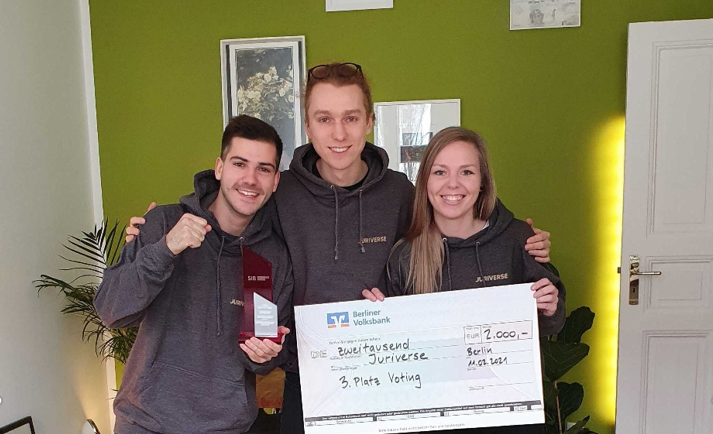
    Juriverse has won third place in the Make It Lean Contest 2020/21 and a prize of €2,000!
    Their idea? A platform for free learning materials in law school that students need to optimally prepare for exams and with which authors can earn money.
    Juriverse identified a problem in their environment, tackled it, and want to solve it — this is exactly the kind of mentality we love to support, including through our Startup Now Programme! But how did it all come about, and what else does the Juriverse team have planned? We asked them…

    1) How did you find out about the Make It Lean Contest?
    We became aware of the Startup Incubator Berlin through our consideration of applying for the Berlin Startup Scholarship. That’s where we then also discovered the Make It Lean Contest.

    2) How and when did you come together as a startup team?
    Marvin and Laura have known each other since school. Lucca became a good friend and is now a co-founder through CODE University. So we have all known each other for several years and make a strong team. We also bring together the necessary skills. Laura takes care of legal topics and operations, Lucca handles the technical side, and Marvin looks after product management. We are additionally supported by great legal professionals from across Germany and a network from the startup industry.

    3) How did you come across the problem that you want to solve with your startup idea?
    Laura is herself a law student, so we have our user persona right within the team. When she told us one day about her challenges in law school, we took a closer look at the topic and saw great potential for innovation there. In the meantime, user interviews with law students and conversations with professors have confirmed that there is indeed room for improvement in this area.

    4) What is your most important goal in the next 3 months?
    To make law school less daunting and stressful for law students through our initiatives and materials. In law school, it’s not just about access to the right materials. Above all, it’s about conveying knowledge of how students need to work with the relevant materials — combined with feedback on students’ own solutions.

    5) Who would you like to have a coffee or tea with? Why?
    With investors who ideally have a legal background, or lawyers who are looking for a passion project and want to support it.

  • 5 Questions for… Aam Digital

    5 Questions for… Aam Digital

    Aam Digital has been part of the Startup Incubator Berlin since 2021 and is supported by the Berlin Startup Scholarship.

    Aam Digital is a social enterprise that has developed software for the global social sector. This enables social projects to work more effectively while simultaneously generating reliable data for monitoring and evaluation. Aam Digital can be adapted to any use case in the social sector and is currently actively used in social and educational work. Through their software-as-a-service model, they enable even organizations with limited financial resources to work more effectively and impact-oriented.

    We asked the founders 5 questions to find out how they came up with their wonderful idea, how they found each other as a team, and more…

    1. How and when did you come together as a startup team?

    Sebastian brought Aam Digital to life as an open source project during his time as a project manager in Calcutta, where he met our co-founder Simon. When the decision was made to build a social enterprise, Moritz came on board — he had just finished his master’s degree in London and has a professional and academic background in development cooperation. As a result of our great collaboration with the company TolaData, we were also able to bring Malte on board. Malte has founded and supported successful social enterprises on three continents and accompanies Aam Digital GmbH as an advisor and co-shareholder. We have been working since summer 2020 on our plans to advance the global nonprofit sector with our social enterprise. Since the founding of Aam Digital GmbH in March, it is finally official.

    2. How did you come across the problem you want to solve with your founding idea?

    During our activities in the NGO sector, we noticed that most people today unlock their phones with a fingerprint, yet work in the global social sector is mostly still documented analogously or in self-built Excel systems. This results in critical cases often going undetected, and reliable data for monitoring and evaluation being absent. The potential to increase effectiveness in the sector is enormous, and yet there is a mismatch between the need for digital tools and the supply — that is what we want to change!

    3. What do you want to/can you do better than other providers on the market?

    “Too complex, too expensive, the servers are not in Europe.” That is how our customers describe our competitors. Aam Digital is the opposite: simple, affordable, and GDPR-compliant. Also crucial is our self-image as a social enterprise: unlike publicly listed CRM systems, we share the objectives of our customers and always keep all stakeholders in view. This is not just lip service, by the way — it is part of our articles of association!

    4. What is your most important goal in the next 3 months?

    Our most important goal is to find business partners who want to work with us to make the global social sector more effective and transparent. We are looking for companies with complementary products, new customers, and compelling impact investors. While we are already generating revenue, there is still a lot to do before we achieve our desired social impact.

    5. Who would you like to have a coffee or tea with? Why?

    There are quite a few in the field of social entrepreneurship: High on our list would be Bill Drayton, the founder of Ashoka and one of the pioneers in promoting social entrepreneurs. With Aam Digital, we want to not only be economically successful but also advance society. But to achieve more, we also need partners and investors for that. Ashoka has built an impressive network in this regard.

  • Make It Lean Contest – Interview: UrbanFarm

    Make It Lean Contest – Interview: UrbanFarm

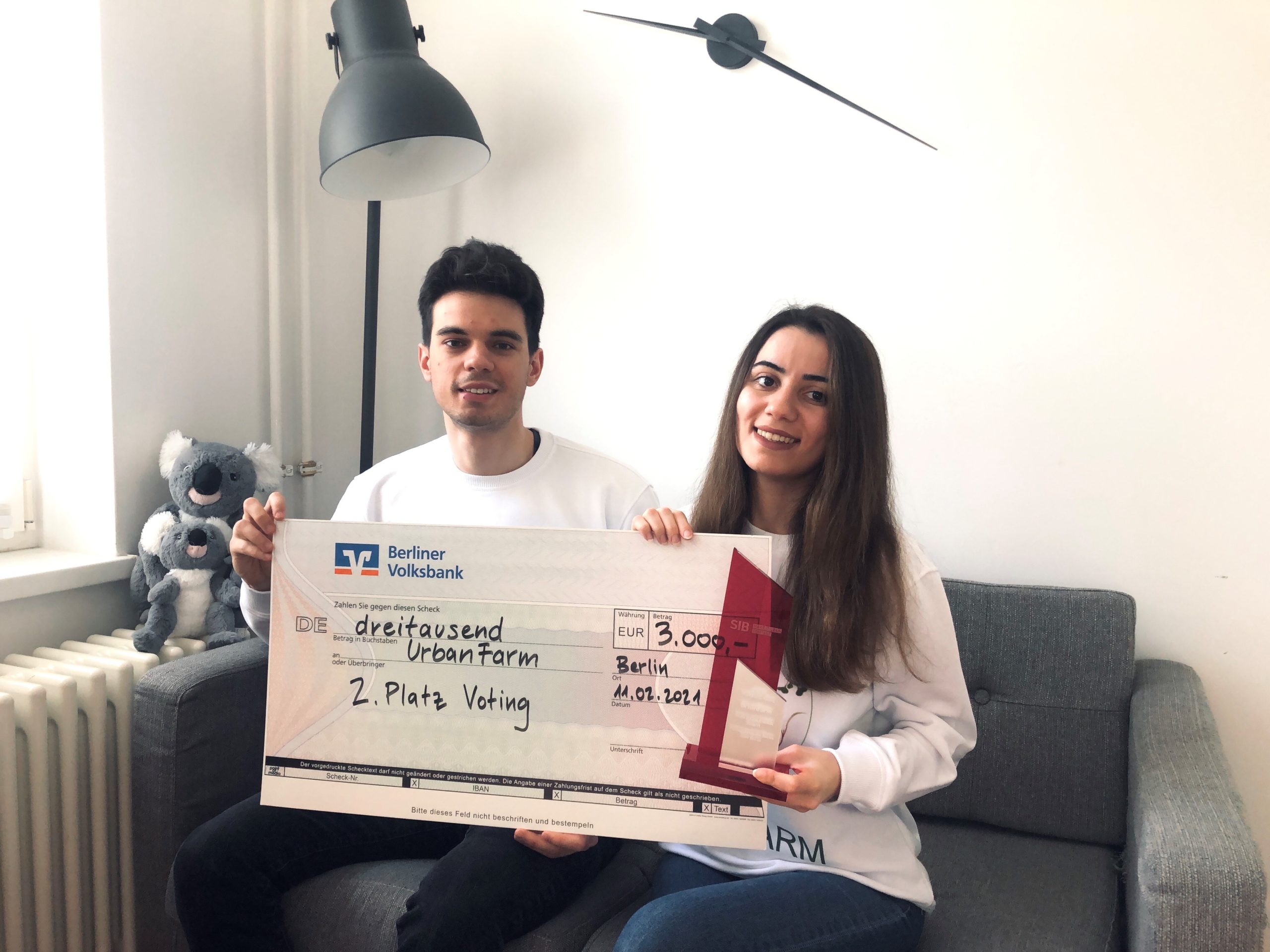
    UrbanFarm won the second place of the Make It Lean Contest 2020/21 and with that 3.000€ price money for their startup project.
    Their startup is an environmentally friendly, mobile production system for nutrient-rich microgreens that uses the recycling of food waste from restaurants for their own needs on site.
    As sustainability gets more and more important, UrbanFarms project is spot on. So we were curious, how did they came up with their idea and what are their plans for the future?

    1) How did you find out about the Make It Lean Contest?
    We came across the Make It Lean Contest while we were searching for support programs for startups.
    Then we thought that this contest would be a great chance to share our idea with a large audience and opportunity to get support by every means.

    2) How and when did you get together as a startup team?
    We got together around this idea in October 2020. We have already known each other for a while and both of us wanted to create value for the whole society then we started thinking.

    3) How did you come across the problem that you wanted to solve with your founding idea?
    We have always wished to find a solution for increasing demand for food. With the pandemic, this demand became more significant than ever.
    All of us -even in the big cities- felt the fear of not having enough food in the groceries to feed ourselves.
    Therefore we wanted to find a way to grow food for people in the cities in another manner creating self-sufficient cities. About recycling food waste, Ecem has seen the big issue how much food goes away everyday.
    Since she is a chemist, she proposed to use this food waste as a fertilizer and grow organic food without chemicals.

    4) What is your main goal in the next 3 months?
    We have already set up our prototype system and in the next three months our goal is to launch our operation and present our products in the market. We are currently working on that step by step.

    5) Who would you like to have a coffee or tea with? Why?
    Well, that’s a tough one. If he was alive, definitely Henry Ford. He had a great vision and much ahead of his time.

  • Make It Lean Contest – Interview: Fainin (Partiri)

    Make It Lean Contest – Interview: Fainin (Partiri)

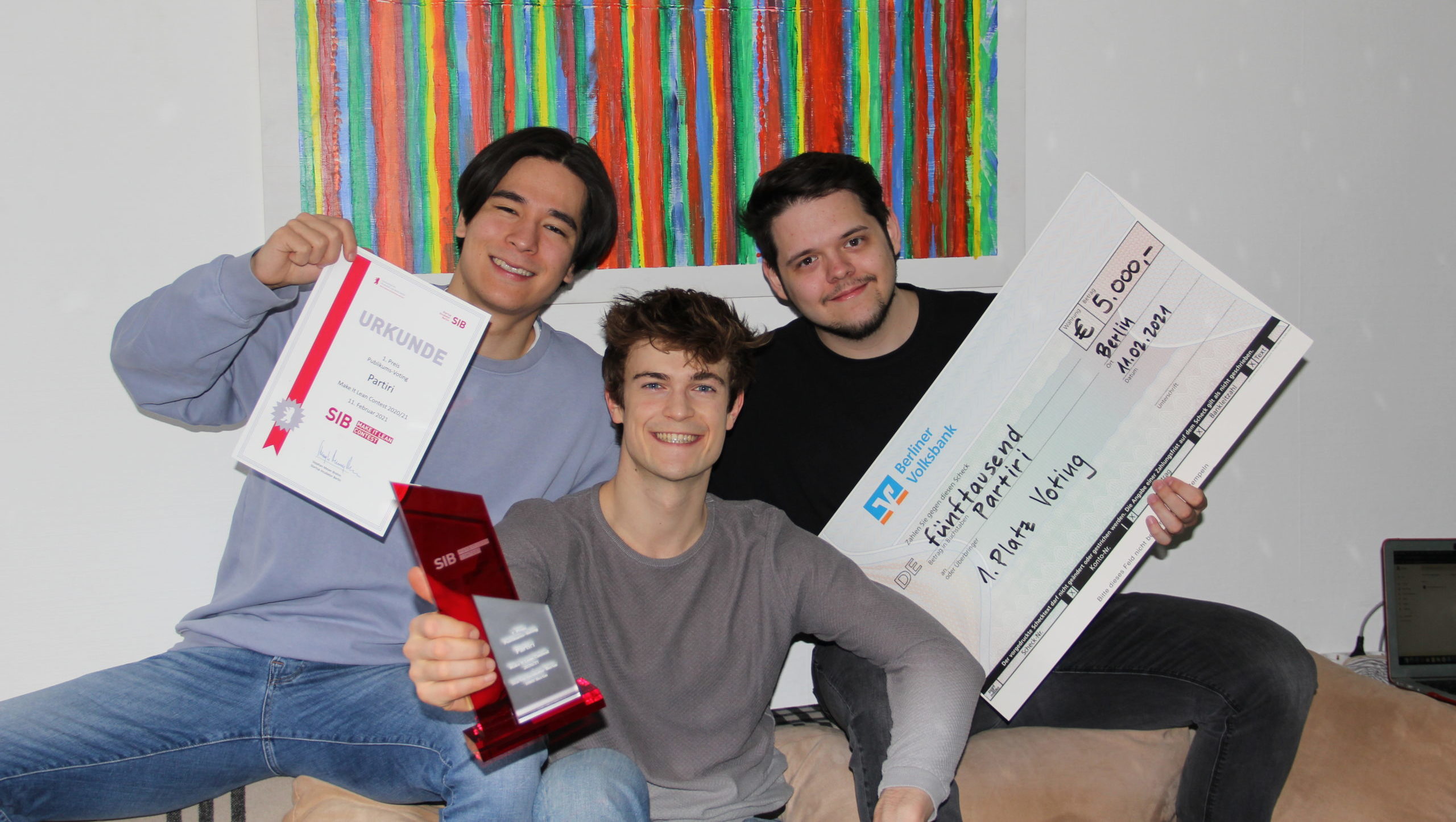
    As Partiri, they took 1st place in the Make It Lean Contest 2020/21 and won €5,000 for their startup.
    Their idea of a sharing platform for everyone willing to share items in order to promote sustainable consumption and protect the environment resonated with the founders of Fainin, who pursue the same goal. This led to a merger of the two sharing apps — Partiri is now operating as Fainin to continue driving their sustainable project forward.

    We find it exciting to watch teams evolve that have been or still are in contact with the Startup Incubator Berlin. Whether through one of our programs or at our founding competition, the Make It Lean Contest.
    That’s why we asked the Partiri/Fainin team a few more questions to learn more about the founders and their project:

    How did you become aware of the Make It Lean Contest?

    At the time, we participated in the Make It Lean Contest under the name of our former project “Partiri.App”. A friend from the Partiri family pointed us to several contests. Since we focus on a “lean” approach in our IT development and community roadmap, we identified with the competition right from the start. We also calculated our chances of winning to be high given our social, sustainable, and community-oriented business model.

    The MILC helped us far beyond the community boost and prize money: the founders of our biggest competitor “Fainin” took notice of us and offered to merge the two sharing apps. We can help them a great deal with community building and marketing, and we benefit from their existing partnerships — such as with insurance providers and payment service providers — as well as their IT infrastructure. True to the Partiri/Fainin principle: a win-win for everyone involved, because #SharingIsTheNewOwning.

    How and when did you come together as a startup team?

    We launched Partiri.App in November/December 2019. At the beginning we started with surveys and a business plan, but as the project progressed we kept learning continuously, and this summer we are also launching the app under the name “Fainin” – Find Anything In Your Neighbourhood.

    Johann and I (Max) know each other from our International Management studies — we had worked together as part of a course and together dreamed of the benefits of a secure sharing community. After we communicated our project a little within our social circle, we were introduced to our IT genius, Kevin. He identified strongly with our dream and was ultimately convinced by our business plan to come on board. Since that day we have grown closer and closer and have already become friends for life.
    We also each had the opportunity to write our respective bachelor’s/master’s theses about our project:

    1. “The Optimal Business Model in the Collaborative Industry” – Maximilian Lehmann
    2. “Acceptance Characteristics of Sharing Solutions” – Kevin Mattutat
    3. “Financing Options for Pre-Seed Platforms” – Johann Lißner

    The accumulated theoretical knowledge helped us to shape our sharing project as promisingly as possible. It is astounding how many books address the rise of the sharing economy and the advantages of collaborative approaches: for example, Jeremy Rifkin’s “The Zero Marginal Cost Society”, in which he describes how the Internet of Things and collaborative cooperation lead to a decline in global production costs. With this, he prophesies a reorientation of society in favor of a community-oriented society. A dream that truly connects all three of us deeply — with this conviction we gladly emphasize our motto #SharingIsTheNewOwning.

    How did you come across the problem that you want to solve with your startup idea?

    The idea came to me (Max) after moving from the 105-inhabitant village of “Metzenhausen” to Hamburg. I fell in love with the city immediately, but at first I missed the interpersonal closeness from my home in the Hunsrück region. I quickly identified one key reason for the lesser sense of connection: people in cities don’t know each other. In Metzenhausen, everyone knows everyone. That’s why people support each other. It’s completely normal for the Lehmann family to share things with all the neighbors — for example, the lawnmower and the party equipment for annual birthdays. This leads to communication and further strengthens trust.

    Fainin is meant to make exactly that possible all over the world. Creating trust within the sharing community through a secure and automated verification and lending system.”

    What is your most important goal in the next 3 months?

    We want to release Fainin’s application in a beta version in May 2021 and test and optimize our infrastructure with initial interactions. Fainin should become established within our circle of friends and be gradually completed with additional features. This way we can already kick off our community with a “soft launch” in the summer, and then establish the group function with a “hard launch” and optimized infrastructure. This is intended to be the starting shot for a cluster-like establishment of our network: initially, Fainin will position itself as a sharing network for students at universities, athletes in clubs, and neighbors in districts. This ensures that members have a common local connection and may even become friends through our interaction features.

    Who would you like to have a coffee or tea with? Why?

    We would love to have a coffee with Brian Chesky, Nathan Blecharczyk, and Joe Gebbia. They are the Airbnb founders that hardly anyone believed in at the start. They were told things like “The business model won’t work” or “Would you trust strangers?” But instead of letting that get them down, they simply kept going and realized their vision. We are very inspired by their determination and their belief in creating something big and positive for the world and everyone involved with their startup.

  • Make It Lean Contest – Interview: Cabin Experience

    Make It Lean Contest – Interview: Cabin Experience

    Interview with Cabin Experience about the Make It Lean Contest

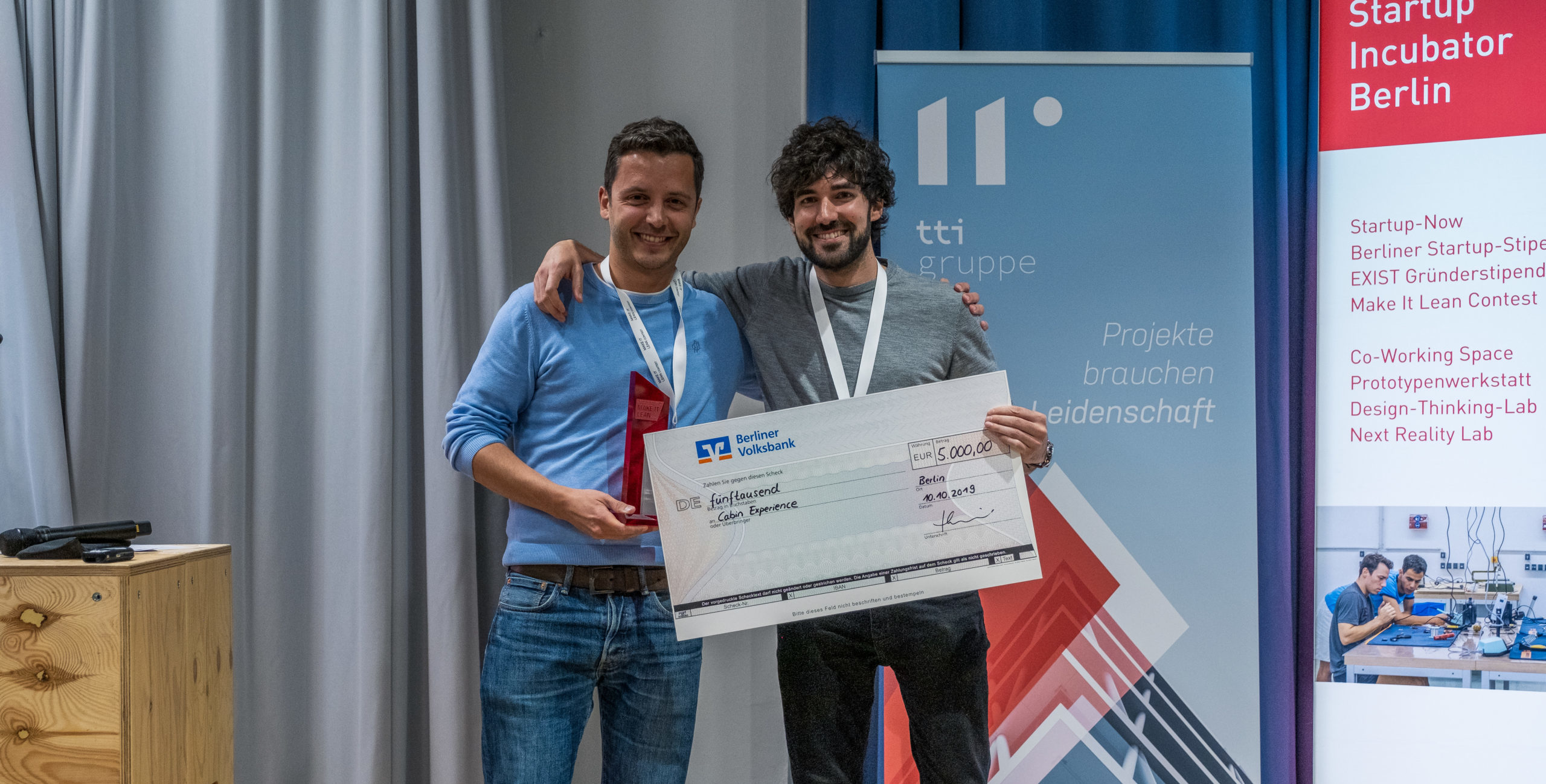
    Cabin Experience won first prize at the Make It Lean Contest 2019 with the idea of creating a new, more sustainable form of vacation in harmony with nature. To this end, the team developed a digital platform that connects three key players:
    1) Buyers and/or co-owners find their perfect tiny house along with an opportunity to finance their cabins through rentals, 2) landowners in nature-adjacent, less developed areas find a way to generate additional income by hosting such cabins, and 3) vacationers find an individual travel experience far from civilization and mass tourism. We spoke with Javier Sanjurjo (JS) about the development of their company at Startup Incubator Berlin (SIB):

    SIB: How and when did you come together as a startup team, and how did you arrive at your idea?

    JS: We first met privately at a friend’s wedding, and even then we noticed that the chemistry between us was right. From there, the idea of founding a startup together emerged. We both already had experience at large companies and wanted to build something of our own. And in the course of many subsequent conversations, we discovered our shared passion for ecologically meaningful tourism, and our idea developed quite naturally from there.

    SIB: How did you find out about Startup Incubator Berlin and the Make It Lean Contest?

    JS: We got to know the SIB while still searching for our startup idea — back then at the previous location in Schöneberg. We attended events there such as UX testing and realized it could be a great environment for us. When the Make It Lean Contest was announced there again, it seemed like the perfect way to put our idea out there without taking a big risk.

    SIB: What ultimately tipped the scales toward actually participating?

    JS: We felt that at that point we could use a little external pressure to finally bring out and make visible all the ideas in our heads. Most importantly: How would we tell our story, how do we want to present ourselves, how do we interact with our customers? Of course, we were also motivated by the fact that we would receive plenty of great support through the workshops at the SIB.

    SIB: And how did you specifically prepare?

    JS: Oh, it really was like a full-time job! We did so many things: our own user interviews within our circle of friends, gathered lots of feedback, revised everything again and again. Really very hands-on, following the Lean method: Build – Measure – Learn, and that in many, many cycles.

    SIB: And what role did your video play in all of this?

    JS: That’s probably where we invested the most time in the end! The workshop on it was really super helpful, and then we dove in really deep for 3 weeks: We sourced images and video material from public databases, then took care of the editing and sound ourselves. But all the work was well worth it!

    SIB: The video turned out so well that you received over 25% of all votes in the voting?

    JS: (laughing) Of course! No, we also put a lot of effort into the voting phase: We made targeted, regular posts on Facebook, LinkedIn and Instagram pointing to the public vote. We also made “cold calls” to multipliers, associations, tour operators, etc. In addition, we specifically approached journalists and got interviews on radio and television — including in Spain and France, where my partner Charles and I are from. When I was on flights, I simply approached fellow travelers directly in the boarding area — so we ended up with many fans and votes from all over the world!

    SIB: And after winning the contest, how did things continue?

    JS: As I mentioned, we already knew Startup Incubator Berlin beforehand, and we had of course planned to be accepted into their support programs. Things then really unfolded by the book: We first joined the Startup Now program and then successfully applied for the Berlin Startup Scholarship.

    SIB: Speaking of “by the book” — was the Lean Startup method (after author Eric Ries) truly meaningful to you, or is it just a nice theory?

    JS: We both already knew the method before working together at Cabin Experience. So it came quite naturally for us to revisit the Lean Canvas over and over again. We have gone through several further developments and realignments, and for that, a structured tool like this is absolutely useful for achieving shared clarity about the path ahead.

    SIB: What were the best and the most difficult moments in your journey at Startup Incubator Berlin?

    JS: Of course, it was very difficult for us that we launched Cabin Experience right into the middle of the Corona crisis. Tourism came to a global standstill, and even the world’s largest travel trade fair in Berlin was cancelled. There was and still is great uncertainty, and the rules of the game in this market are changing massively. Our important collaboration with partners in other European countries became extremely difficult due to travel restrictions. But in the medium and long term, our idea of sustainable, individual tourism in nature will become even more attractive as a result of such a crisis. The truly best part of our time on-site at the SIB was the wonderful collaboration with the other startups. There was no competition — everyone supported each other and willingly shared their experiences.

    SIB: And where do you stand today, about a year after winning the Make It Lean Contest?

    JS: We have just launched our new website, which clearly explains our benefits for all parties involved (cabin owners, landowners, and travelers). Our new products are aimed primarily at people with a garden or plot of land who are looking for an extra space to work or relax in nature. The models are even more minimalist than traditional tiny houses, but more affordable and very easy to assemble (some of the models can even be self-assembled). For all models we offer a base product with options that can be added on. Unlike larger tiny houses, they are also quick to produce and therefore available within a few weeks. So we have a product on the market that works and with which we can expect to make money. We can hardly believe it ourselves!

    SIB: We always believed in you, and we wish you continued success!

Cookie Consent Banner by Real Cookie Banner